
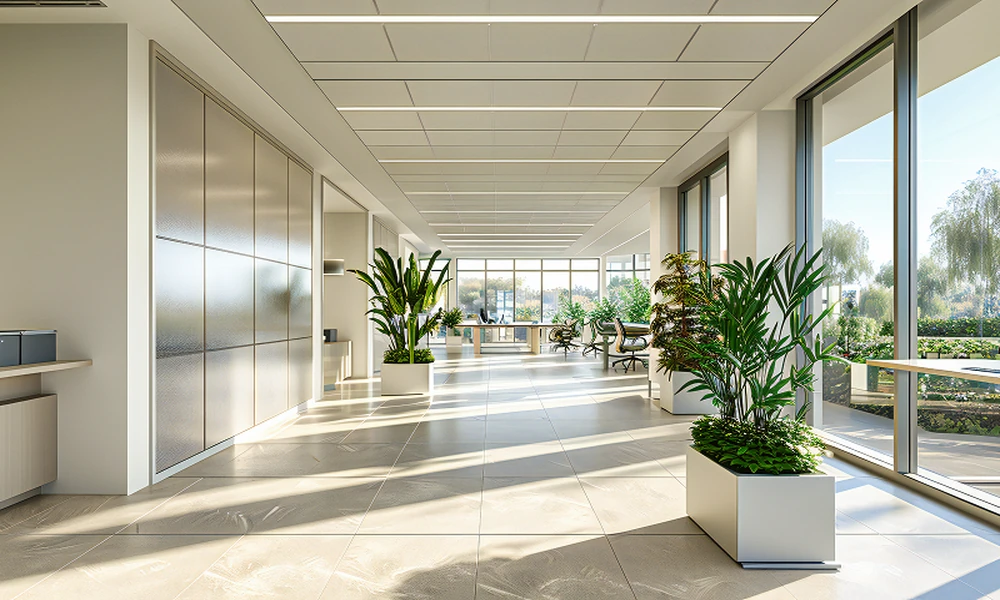
Office plants grow under conditions that can differ considerably from those outdoors. Light levels, air-conditioning, watering practices and container size can all influence how office pot plants respond to their surroundings.
Misunderstandings about plant care often arise when general rules are applied to every species or environment. Understanding how plants respond to water, light, temperature and nutrients can help explain why care should be based on actual growing conditions rather than fixed assumptions.
Misconception 1: Office Plants Should Be Watered on a Fixed Schedule
A common assumption is that indoor plants should be watered on the same day every week. However, water use varies according to plant species, pot size, growing medium, temperature, humidity, light and the stage of growth.
A fixed schedule can therefore result in a plant receiving water before its growing medium has dried sufficiently. Continually wet conditions can reduce the amount of oxygen available around roots and contribute to root problems.
Before watering, several factors can be checked:
- Growing medium: The surface may appear dry while deeper layers remain moist.
- Pot weight: A container often becomes lighter as its growing medium dries.
- Drainage: Containers need a way for excess water to escape rather than collect around roots.
- Plant characteristics: Succulents and other drought-tolerant plants generally have different moisture requirements from tropical foliage plants.
The warm, humid outdoor climate associated with plants in the city-state does not necessarily reflect conditions inside an air-conditioned building. Indoor watering should therefore respond to the plant and its immediate environment rather than the calendar.
In summary, watering frequency is not universal. Checking moisture conditions before watering provides a more useful basis for deciding whether a plant requires additional water.
Misconception 2: All Office Plants Need Direct Sunlight
Plants require light for photosynthesis, but this does not mean every indoor plant requires direct sunlight. Different species are adapted to different light intensities, and some plants naturally grow beneath taller vegetation where sunlight is filtered.
Direct sunlight can also become intense through certain office windows. Plants adapted to indirect light may develop leaf damage when suddenly exposed to stronger sunlight than they can tolerate.
Office light conditions can generally include:
- Direct light: Sunlight reaches the plant without being substantially obstructed.
- Bright indirect light: The location is well illuminated without prolonged direct sun on the foliage.
- Lower light: The plant receives less natural light, often because it is farther from windows.
- Artificial light: Suitable electric lighting can contribute to plant growth when it provides appropriate intensity, duration and wavelengths.
The suitability of office pot plants should consequently be assessed according to the light available at their intended locations. A plant placed several metres from a window may experience very different conditions from one positioned beside it.
The key point is that plants need adequate light, but adequate does not always mean direct sunlight. Matching a species to the available light is more appropriate than applying one lighting rule to every plant.
Misconception 3: Air-Conditioned Offices Are Ideal for All Plants
Air-conditioning creates relatively controlled indoor temperatures, but this does not automatically make an office suitable for every plant. Air-conditioned environments can have lower humidity than outdoor conditions and may expose plants to continuous air movement.
Plants positioned directly beneath or beside air-conditioning vents can lose moisture more rapidly from their foliage and growing medium. Some species may respond with dry leaf edges, wilting or other signs of environmental stress.
Relevant factors include:
- distance from air-conditioning vents;
- temperature around the plant;
- indoor humidity levels;
- strength and direction of airflow; and
- differences between daytime and after-hours conditions.
This distinction can be particularly relevant when considering plants in Singapore, as species accustomed to warm and humid growing environments may encounter substantially different conditions inside cooled offices.
Air-conditioning itself is therefore neither universally beneficial nor harmful. Plant suitability depends on the species and the specific microclimate created around its location.
Misconception 4: More Fertiliser Makes Office Plants Grow Faster
Fertiliser supplies essential plant nutrients, but increasing the amount does not automatically produce faster or healthier growth. Plants can use nutrients only within certain limits, while growth is also constrained by factors such as light, water, temperature and root health.
Excessive fertiliser can cause soluble salts to accumulate in the growing medium. High concentrations can damage roots and may contribute to leaf-tip or leaf-margin injury.
Appropriate fertilisation depends on factors including:
- plant species and growth rate;
- type and concentration of fertiliser;
- condition of the growing medium;
- season or active growth pattern; and
- manufacturer application instructions.
Fertiliser cannot compensate for inadequate light, poor drainage or unsuitable watering. Correcting the underlying growing condition is therefore important before assuming that additional nutrients are required.
In summary, fertiliser supports plant nutrition rather than forcing growth. Applying an appropriate amount according to plant needs is preferable to assuming that more fertiliser produces better results.
Reach out to D’Spring and let us guide you through building a better environment for office plants.